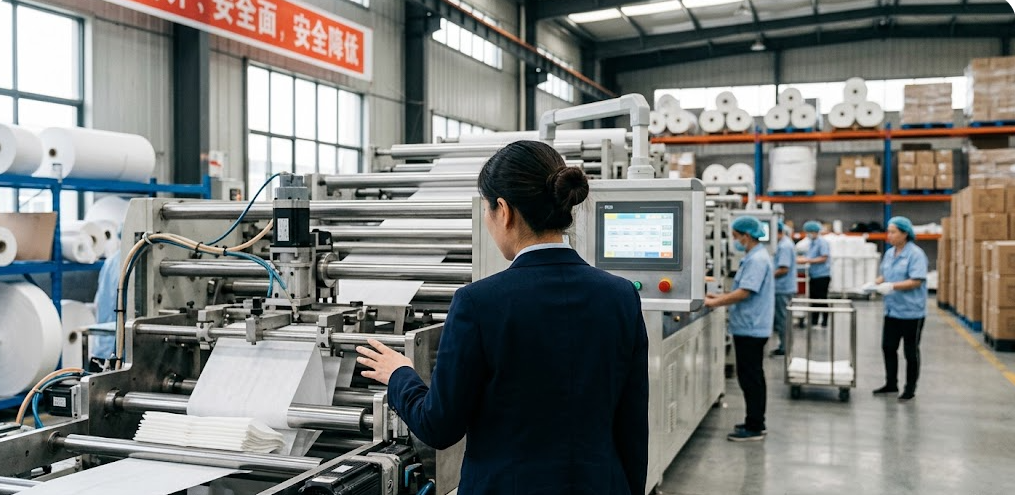
If you’ve been in the hygiene manufacturing business for a while, you know that timing is everything. Whether you are looking to replace an aging line or expanding into new categories like disinfectant or biodegradable wipes, 2026 has thrown us a bit of a curveball—but a profitable one if you know how to play it.
As someone who has spent over 15 years navigating the sourcing landscape in China, I’ve seen cycles come and go. Right now, we’re seeing a “perfect storm” that heavily favors overseas buyers: the technology in Chinese high-speed machinery has finally matured to European standards, and the US Dollar is giving you a massive head start on your ROI.
The Technical Reality: Moving Beyond “Cheap” Machines
Let’s be honest—anyone can find a cheap machine on a B2B portal. But in a high-speed wet wipe production line, the “cheap” option usually shows its true cost three months in, when the timing belts slip or the wetting system starts leaking.
When we audit factories for our clients at Zhenbao Trading, we look for a few specific technical markers that separate a hobby-grade machine from a 24/7 industrial workhorse:
- True Servo Integration: We aren’t just talking about one or two motors. A reliable 2026 line should use a multi-axis servo system. This isn’t just a “fancy feature”—it’s what allows you to change fold patterns or pack sizes via a touch screen without spending six hours with a wrench in your hand.
- The “Closed-Loop” Liquid Secret: Most quality issues in wet wipes come from uneven saturation. We push for systems with electromagnetic flow meters. It ensures that the first wipe in the pack is just as moist as the last one, which is exactly what your end customers (and their skin) care about.
- Future-Proof Sealing: With the rise of complex laminate films, your packaging unit needs precise PID temperature control. If your sealer can’t handle the newer, eco-friendly recyclable films, your machine will be obsolete in two years.
The Elephant in the Room: The Strong Dollar
I talk to buyers every day who are worried about inflation. But here is the silver lining: The US Dollar’s current strength against the RMB is essentially a “sit-wide discount” on Chinese heavy machinery.
Think about it this way: the same high-spec line that cost you a certain amount last year is effectively 5% to 10% cheaper today just because of the exchange rate. On a six-figure investment, that’s not just “coffee money”—that’s your entire shipping cost covered, or enough to upgrade your PLC system to top-tier brands like Siemens or Omron for better local support.
By locking in a deal now, you are essentially hedging against future price hikes. You get more machine for fewer dollars. It’s a rare window where the macroeconomics actually work in favor of the manufacturer.
Beyond the Crate: Why “Sourcing” is Personal
Buying a machine isn’t like buying a laptop. You’re buying a relationship. At Zhenbao Trading, we’ve seen where the bodies are buried in this industry. We know which factories claim to use “export-grade” steel but swap it for cheaper alloys the moment the deposit is paid.
Our job isn’t just to find you a machine; it’s to be your eyes on the factory floor in Hangzhou or across China. From verifying the electrical wiring logic to making sure the CE certification isn’t just a sticker, we treat your investment like it’s our own.
The Bottom Line
2026 is going to be a competitive year. If you can lower your initial CAPEX by leveraging the strong Dollar while securing a high-speed, servo-driven line, your cost-per-pack will be lower than the competition from day one.
If you’re curious about which specific models are currently performing best under real-world factory conditions, or you want to see how the current exchange rate affects your specific quote, let’s have a chat.